


Sofonisba Anguissola (circa 1535 – 1625) was a leading Renaissance painter who managed to rise to prominence at a time when it was nearly impossible for women to pursue an artistic career. Born in Cremona, she quickly demonstrated remarkable skill in portraiture, receiving praise even from Michelangelo Buonarroti and, in her later years, offering guidance to a young Antoon Van Dyck.
Meeting Michelangelo
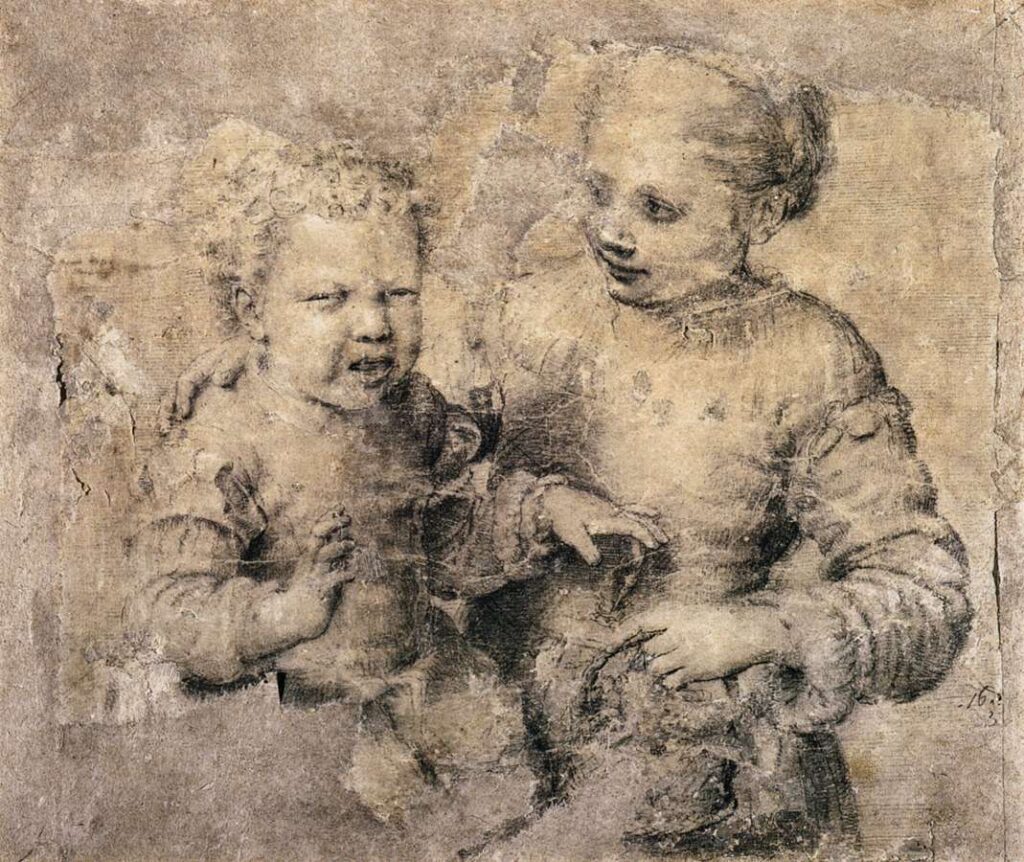
According to sources (including Filippo Baldinucci and several period letters), Sofonisba Anguissola’s youthful talent drew Michelangelo’s attention, prompting him to challenge her with a drawing to test her abilities. Sofonisba responded with the study of a crying child, impressing the great master with the piece’s extraordinary emotional depth. This episode cemented her reputation as an artist “capable of depicting human passions.”
A Time of Great Cultural Upheaval
The sixteenth century was an era of profound cultural change in Italy, but also rife with prejudice that restricted women from studying art. Despite these barriers, Sofonisba, aided by the Anguissola family’s support, trained under renowned artists such as Bernardino Campi and Bernardino Gatti. The cultural climate in Cremona encouraged her development and, not long after, led her to the Spanish court.
The Call to Madrid
Her big break came around 1559–1560, when Sofonisba Anguissola was invited to Madrid to serve as a lady-in-waiting to Elisabeth of Valois, the third wife of Philip II of Spain. She painted members of the royal family and moved in international artistic circles, refining her style and earning acclaim for her portraiture.
Marriages and Life Between Sicily and Genoa
After some years, she married the Sicilian nobleman Fabrizio de Moncada and moved to Sicily. When her first husband died, she entered into a second marriage with the Genoese nobleman Orazio Lomellino, without waiting for the king of Spain’s permission. Philip II reacted kindly, and Sofonisba suffered no loss of income as a result. She spent many years between Genoa and Sicily, maintaining her independence and continuing her work as a painter.
Her Encounter with Van Dyck
Toward the end of her life, settled in Palermo, Sofonisba Anguissola received a visit from the young Flemish artist Antoon Van Dyck in 1624.
Despite her advanced age and weakened eyesight, she managed to pass on valuable technical advice. Van Dyck, impressed, claimed he had learned more from that meeting with “a blind woman” than from studying the works of many other masters.
Giorgio Vasari’s Recognition
Giorgio Vasari also mentioned Sofonisba in the second edition (1568) of his Lives, praising her grace and ability to “paint from life and create devotional figures with such art and elegance” that many male painters admired her. Her inclusion in Vasari’s work was a significant endorsement, made all the more remarkable by the fact that she was a woman.
Works and Painting Technique
Sofonisba Anguissola mainly worked in oil on canvas or panel, setting herself apart through:
- Delicate glazes in her portraits, producing incredibly lifelike expressions.
- Attention to detail, from the embroidery on garments to subtle gradations in facial features.
Besides court portraits—where she conveyed each subject’s personality while maintaining official decorum—she produced many self-portraits, thereby asserting her artistic identity. One of her most famous works is The Chess Game (often referred to as The Portrait of the Artist’s Sisters Playing Chess), housed at the Muzeum Narodowe in Poznań, Poland.
Twentieth-Century Rediscovery
For a long time, only specialists remembered Sofonisba. A significant reappraisal occurred during the twentieth century, culminating in exhibitions such as “Sofonisba Anguissola e le sue sorelle” (Cremona, 1994) and “A Tale of Two Women Painters: Sofonisba Anguissola and Lavinia Fontana” (Museo del Prado, 2019). These events, along with scholarly publications, restored her to the prominent place she deserves in the history of Renaissance art.
Conclusion and Invitation
Today, Sofonisba Anguissola is recognized as one of the most outstanding sixteenth-century painters—a symbol of female emancipation and artistic originality in a male-dominated world. Her portraiture skills and her keen attention to psychological nuance make her a unique figure in art history.
If you want to delve deeper into every facet of Sofonisba Anguissola’s life and works, I invite you to read my full post on Patreon. There, you’ll find even more detailed information and previously unpublished insights on this extraordinary artist. I look forward to seeing you there!
