


Ambrogio Lorenzetti is the younger brother of Pietro Lorenzetti and will have more artistic fortune than him.
He was born around ’85 and died in ’48.
Madonna di Vico l’abate
The Madonna di Vico l’abate is a small panel but monumental in its image. It is dated 1319 and represents an artistic monument of great importance.
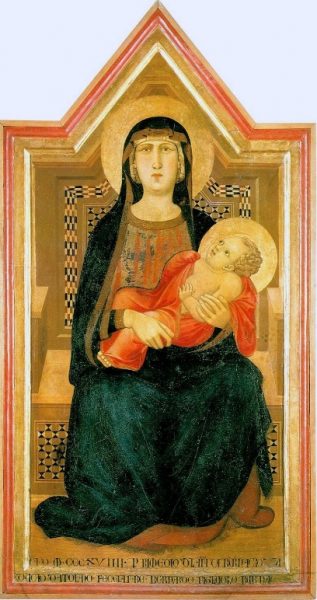
Author Ambrogio Lorenzetti
Date 1319
Technique tempera and gold on wood
Dimensions 150×78 cm
Location Museo di San Casciano, San Casciano in Val di Pesa
Source: Wikipedia, public domain
Duccio di Buoninsegna dies in this period, Simone Martini is active throughout Italy, Giotto moves in Rome, Padua, Rimini, Florence.
In this work Ambrogio Lorenzetti approaches the dictates of Giotto, anticipates Giotto even if his painting is derived from Giotto.
We observe that in this work Ambrogio establishes a scansion in 7 planes of depth that tend to overlap in a lamellar manner almost like the pages of a closed book, the thickness of the image is minimal but Ambrogio constructs a rigorous but destructive projection of the three-dimensional space, it is not flat, because it is set on 7 perspective planes, not in a three-dimensional manner, while Giotto sets spatially.
The frontal presentation of this Madonna is not a revival of Byzantine frontalism so much so that Ambrogio Lorenzetti also uses the maforion in the Madonna’s hairstyle, it is used to give convex value to the head of the Madonna, then Ambrogio takes an antiquated element but uses it in a new way, we observe that the head has a minimal sfumato but is not flattened, this derives from the fact that we have an asymmetry of the right side on the left that makes the neck turn.
This prevents the head of the Madonna from flattening.
We observe that in the right hand the Madonna raises the index finger, in the left she spreads the middle and ring fingers, with this gap of the fingers the hand is inscribed in a three-dimensional space.
Ambrogio Lorenzetti achieves this without the marginal chiaroscuro that Giotto still uses.
It is a fundamental work for understanding the painting of this period.
Allegories of Good and Bad Government in Siena
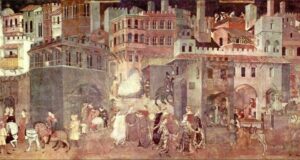
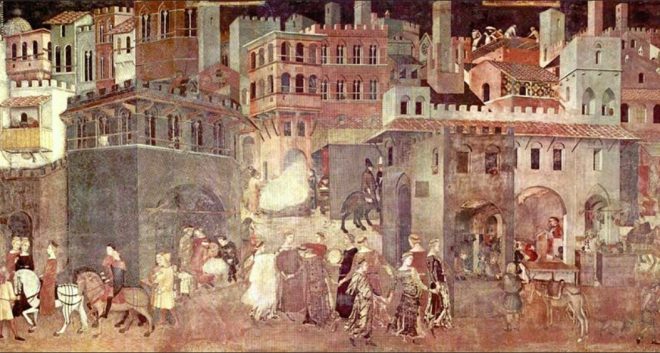
The frescoes in the Palazzo Pubblico of Siena with the Allegories of Good and Bad Government are in the Sala della Pace, inspired by the texts of Aristotle and Thomas Aquinas. They outline an illustration of the political principles on which the Sienese state is based.
The allegories of good government show Justice, which, inspired by Wisdom, governs the Concord between citizens and good government is represented as a king on a throne surrounded by the theological virtues and flanked by the personifications of Justice, Temperance, Magnanimity, Prudence, Fortitude, peace, from which the effects of good government descend.
Bad government is personified by the demon of Tyranny, subdued by the triad of Avarice, Pride, Vain Glory, his court includes allegorical figures: Fury, Division, War, Fraud, Cruelty, effect of a city that crumbles while the sky flies highFear, the countryside is sad, abandoned.
The frescoes in the room represent the cycle on the effects of good government and use all pictorial means to communicate all these effects more directly, with perspective means and lighting systems.
