


Pietro Lorenzetti belongs to the Sienese area, he trained in the workshop of Duccio di Buoninsegna as well as Simone Martini and worked for at least ten years in the Lower Basilica of Assisi in the service of Cardinal Napoleone Orsini.
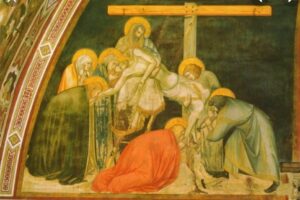
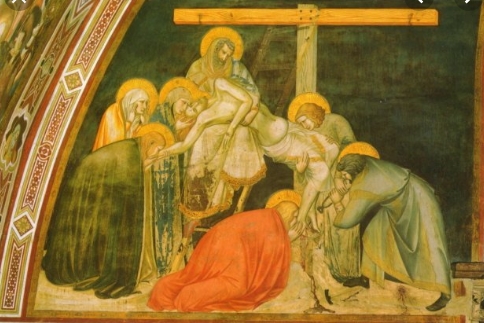
From this period we have a fresco of great visual strength which is the Deposition.
Deposition of Peter Lorenzetti
There is no more tragic composition in the entire Basilica of Assisi than this, which is also a work of great formal severity.
We observe a large T-shaped cross that occupies the center of the compartment that is a lunette.
Date 1310-1319 approximately
Technique fresco
Location Lower Basilica of San Francesco, Assisi
Source: Wikipedia, public domain
But this apparent symmetry is immediately contradicted by the imbalance of the composition entirely in the left area. This creates a diagonal that crosses the entire space from left to right and this diagonal in turn intersects with the diagonal of the staircase.
A tension is therefore created within the work, the overlapping of the two rigid structures (the cross as an inverted triangle and the staggered lozenge of the two diagonals that intersect) contrasts with the apparent layout of the composition on a single plane.
We are in the presence of a dynamic structure within which the painter manages to highlight the volume.
At the base there is a Giotto-esque plasticism and we observe how the figures are inserted as if on a chessboard that becomes the base, the fabric of the painting.
For example, let’s observe how the body of Christ is shattered, inserted in this diagonal line broken by the bending of the knees and the right angle of the arm.
At the end are the two figures of Mary with the green cloak and Nicodemus who unnails Christ’s feet.
In the center under the cross is the figure of Mary Magdalene (in red), the arrangement of the diagonal figures (Mary and Nicodemus), those that lead back to the verticality of the Madonna are to be inserted into the lines on which the painting is set.
Dismantling Pietro Lorenzetti’s Deposition into its spatial directions means understanding the dramatic reason for the work, because the faces are not particularly expressive, but the work is emotional and violent, and the organization of the lines that creates this in the spectator, it is the geometric structure on which the painting is set, in an asymmetrical way, the rigorous layout, the subdued colors, close to monochrome, the only evident ones are the cloak of the Magdalene and the Madonna.
This effect reaches its peak in the broken body of Christ.
The artist then works for the Church of Carmine (the altarpiece) in Siena, on the Nativity of the Virgin, which is one of his masterpieces for the altar of San Sabino.
